And Then There Were None – Agatha Christie’s Ultimate Mystery
Few can think of mystery authors without naming Agatha Christie amongst them. Known as the best-selling author of all time, Christie’s contribution to the genre is unmatched. Her name has become shorthand for intrigue, clever puzzles, and that particular English chill that turns a drawing-room conversation into a scene of high tension. Her works combine the logic of a mathematician with the sensitivity of a psychologist, making her not just an entertainer but an astute observer of human nature.
Her 1939 novel And Then There Were None is widely regarded as her masterpiece. It’s her own personal favourite and continues to captivate readers and audiences nearly a century later. This ingenious story of guilt, justice, and human psychology remains the best-selling mystery novel of all time, translated into over 50 languages and adapted across every medium imaginable—from film and television to stage, radio and even video games. The book’s haunting atmosphere and moral complexity have ensured its place not only in literary history but also in popular culture.
What is Agatha Christie’s most famous book?
When readers worldwide were asked in a 2015 global poll to name their favourite Christie, And Then There Were None took the top spot. It has sold over 100 million copies and remains one of the most recognisable titles in fiction history.
The story follows ten strangers who are invited to a remote island off the Devon coast. Each has been lured there under false pretences—promises of employment, holidays, or reunions—and each harbours a dark secret. Once gathered, a mysterious voice accuses them all of crimes for which they have escaped justice. Then, one by one, the guests begin to die.
What unfolds is a story that redefined the murder mystery: no detective, no way off the island, and no one left to trust. It’s a tense and masterfully paced thriller that keeps audiences guessing until the very last revelation. Its influence can be traced through generations of writers and filmmakers who have attempted, but rarely matched, its perfect balance of structure, suspense, and psychology.
Who was Agatha Christie?
Agatha Mary Clarissa Miller was born in 1890 in Torquay, Devon, into a comfortable middle-class family. She was the youngest of three children and grew up under the imaginative influence of her older sister, Madge, who challenged her to write her first detective story. Her mother, Clara, also encouraged her storytelling talents, fostering a creative environment where reading and imagination flourished. Christie spent much of her childhood reading adventure tales and gothic mysteries from the family library, laying the foundations for a lifelong fascination with plot and suspense.
During the First World War, Christie trained and worked as a nurse at the Red Cross Hospital in Torquay, tending to wounded soldiers. She later qualified as an apothecary’s assistant in the hospital dispensary, where she handled medicines and learned the intricacies of chemical compounds and poisons. This practical experience gave her a rare and authoritative insight into toxicology—a subject she would later employ with chilling precision in her fiction. In fact, poisons are responsible for more than half of the murders across her novels, a testament to both her expertise and her meticulous approach to detail.
Christie’s first novel, The Mysterious Affair at Styles (1920), was written during wartime and introduced the now-iconic detective Hercule Poirot, a methodical Belgian refugee. From that moment, she began an extraordinary literary career that would span more than fifty novels, sixteen short story collections, and a prolific body of stage work. Her 1926 novel The Murder of Roger Ackroyd revolutionised the detective genre with its controversial twist ending, securing her reputation as a master of misdirection.
Her life itself was not without mystery. In 1926, she famously disappeared for eleven days, sparking a nationwide manhunt before being found safe in a Yorkshire hotel—an event that remains debated to this day. Later, she remarried archaeologist Max Mallowan and travelled extensively to excavation sites in the Middle East, experiences that inspired several of her novels, including Murder in Mesopotamia and Death on the Nile.
Christie’s genius lay not just in her intricate plots but in her empathy and psychological insight. Beneath the surface of each puzzle lies a study of guilt, deception, and morality. Despite her immense fame, she remained modest and private, often writing in longhand at her Devon home, Greenway, or on archaeological digs abroad. She is recognised by Guinness World Records as both the best-selling novelist of all time and the most-translated author in history, with works published in more than 100 languages. Her plays, including The Mousetrap—the longest-running production in theatre history—continue to attract audiences worldwide, proving that her appeal transcends generations.
What is a locked room mystery?
A “locked room mystery” is a type of crime story where the circumstances of the crime appear impossible—committed in a sealed space, with no visible way for the culprit to have entered or escaped.
In And Then There Were None, Christie takes this concept to its most extreme form. The entire island becomes a locked room. The sea cuts the characters off from the mainland, and when the weather turns, no help can come. As the tension mounts, each character realises the murderer must be one of them. The isolation magnifies every fear, suspicion and moral failing, making this not only a whodunnit, but also a psychological study of guilt and paranoia. The confined setting allows Christie to explore the fragility of civility under pressure, where suspicion erodes trust and survival instincts override morality.
Who are the main characters in And Then There Were None?
The novel’s ten guests each bring their own secrets, personalities, and moral flaws to the island. Together, they form one of Christie’s most memorable ensembles:
- Justice Lawrence Wargrave – A retired judge with a commanding presence and a sharp mind, Wargrave embodies authority and moral judgment.
- Vera Claythorne – A former governess whose poised exterior hides deep guilt over a tragic drowning incident.
- Philip Lombard – A soldier of fortune with charm and arrogance, known for his past misdeeds in Africa.
- Dr. Edward Armstrong – A successful physician whose overconfidence once led to a fatal mistake on the operating table.
- William Blore – A former police inspector posing as a detective, compromised by corruption and false testimony.
- Emily Brent – A pious and self-righteous spinster, convinced of her own moral superiority.
- General John MacArthur – A war veteran tormented by memories of sending a young officer to his death.
- Anthony Marston – A reckless, glamorous young man whose carelessness cost two children their lives.
- Thomas and Ethel Rogers – The butler and his wife, servants bound by guilt and fear for a crime they committed together.
Each character is confronted by the weight of their conscience, and through their gradual unravelling, Christie constructs a social cross-section of British society—one where class, morality, and justice collide under pressure.
What is the novel And Then There Were None about?
At its core, the novel is about justice and conscience. Each guest has committed a crime—indirectly or otherwise—for which they have escaped punishment. Their mysterious host, signing himself “U.N. Owen” (a play on “Unknown”), has decided to deliver that punishment himself.
The deaths follow the lines of a sinister nursery rhyme, “Ten Little Soldiers,” displayed in each guest’s room. As the rhyme counts down, the guests die in corresponding ways—an unnerving device that builds unbearable suspense.
With no detective to save them, the characters must face their guilt, their fear, and ultimately their fate. The novel ends with a chilling confession that ties the puzzle together in one of the most ingenious finales ever written. Christie herself described the writing process as her greatest technical challenge, and it remains a landmark in the evolution of the modern thriller.
What is the main theme of the book?
The principal theme is moral reckoning. Christie strips away society’s comforts and exposes the idea that guilt cannot be buried forever. The island becomes a kind of purgatory where each guest is confronted by their conscience.
Other recurring themes include isolation, fear, justice, and the illusion of respectability. Many of the victims are outwardly successful, even virtuous—but under pressure, their facades crumble. Christie’s brilliance lies in showing that evil doesn’t always look like a villain in the shadows; sometimes it wears polite smiles and afternoon tea. Her subtle character studies reveal how pride, denial, and cowardice can be just as dangerous as malice itself.
This dark, introspective quality marks And Then There Were None apart from Christie’s lighter detective tales and makes it one of her most haunting and philosophical works.
When was And Then There Were None adapted for stage?
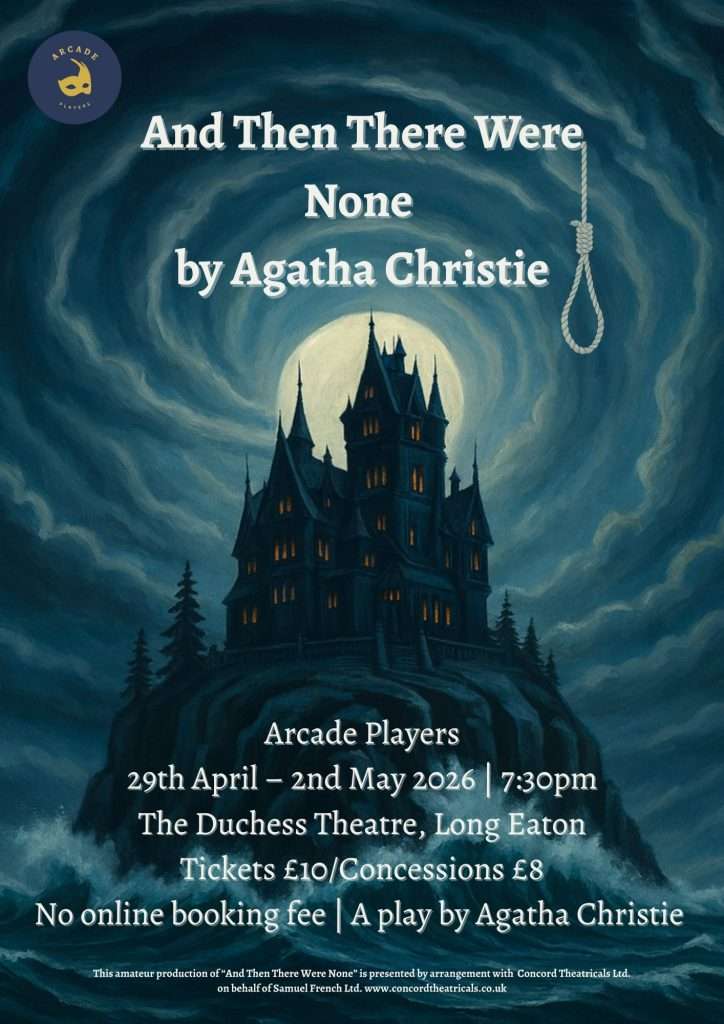
Christie adapted her own novel for the stage in 1943, just four years after its publication. The play debuted in London’s West End and was an immediate hit. It has since become a staple of amateur and professional theatres alike, including our own upcoming Arcade Players 2026 production, which will bring the suspense and atmosphere of the story to the Duchess Theatre stage.
The claustrophobic island setting, the ensemble of flawed characters, and the escalating tension make it ideal for live performance. Directors continue to find new ways to interpret the story—whether leaning into its psychological darkness, its period authenticity, or its moral complexity. Each version offers a new perspective on Christie’s chilling vision of justice without mercy.
Why are there two endings?
Christie’s story is famous for having two distinct endings. The original novel concludes in a much darker and more unsettling way, while the stage adaptation introduces a more hopeful resolution. To preserve the experience for new audiences, productions rarely reveal in advance which ending they will use—keeping audiences guessing until the final moment.
This duality adds to the play’s intrigue: some versions lean into its psychological horror and moral bleakness, while others offer a glimmer of redemption. Both endings carry Christie’s unmistakable signature—sharp, surprising, and designed to linger long after the curtain falls.
The Enduring Appeal
Eighty-five years on, And Then There Were None continues to fascinate because it taps into universal fears—being trapped, being exposed, being judged. Its careful blend of morality, mystery, and suspense ensures it will never go out of style. Whether you encounter it on the page, the screen, or the stage, it remains Agatha Christie’s most chilling masterpiece—and a story no one ever forgets.
Christie’s legacy endures not just because she wrote compelling puzzles, but because she understood people. Her mysteries remind us that truth has a way of surfacing, guilt is a silent companion, and justice—however delayed—always finds its mark.